Item : 418678
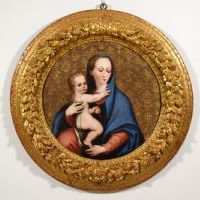
Madonna of Purity, 17th-century painter active in central Italy, oil on panel
Period: 18th century
Madonna of Purity, 17th-century painter active in central Italy
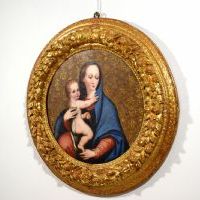
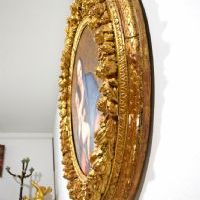
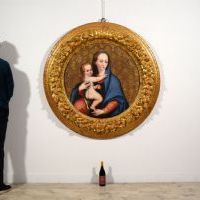
Oil on panel. Measurements: frame diameter 142 cm. Panel diameter 93 cm
Price: confidential negotiation
Object accompanied by a certificate of authenticity and analysis from the Thierry Radelet restoration and analysis laboratory.
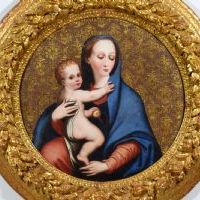
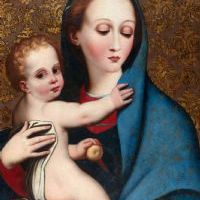
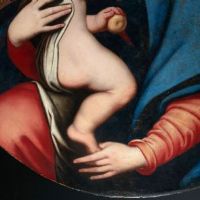
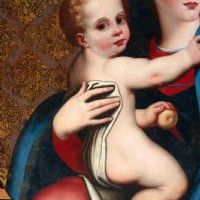
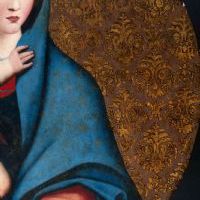
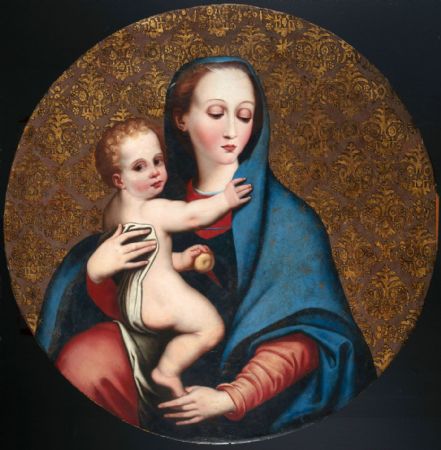
The painting, executed in oil on a circular panel and presented within an imposing carved and gilded wooden frame, depicts the Madonna of Purity, an iconographic representation of the Virgin Mary particularly widespread in Italy, especially in the Kingdom of Naples, where there was an important pictorial tradition linked to this devotion. The image of the Madonna of Purity originated in Jesuit circles and is closely associated with the devotion promoted by the Order of Theatines, founded by Saint Cajetan (1480-1547). Its iconography is linked to the spirituality of the Virgo Purissima, exalted by the Council of Trent (1545-1563), which strengthened Marian devotion and the doctrine of the Immaculate Conception. One of the best-known prototypes is the painting of the Madonna of Purity kept at the Theatine convent in Naples, created by Luis de Morales (1510-1586), a Spanish painter active in the late Renaissance. This work was brought to Naples by the Theatines, donated by the priest Diego Di Bernardo y Mendoza, and became an iconographic model for subsequent depictions. The Virgin is characterized by an ethereal appearance, with traits of humility and candor. Covered with an ultramarine blue mantle, which envelops her head and shoulders, and wearing cinnabar red, she keeps her eyes half-closed as a sign of humble detachment and obedience to the divine will. With her right hand, she embraces the Baby Jesus and, in the act of supporting him, delicately caresses his right foot with maternal tenderness. The Child is portrayed in a delicate movement of the body that appears in precarious balance. Seated on the Virgin's right knee, he turns his head outwards, with eyes that convey a serious rather than smiling communicative gaze, while with his right hand he holds a corner of his mother's mantle, as if wanting to fold it modestly over her face. In his left hand, a glimmer of an apple can be seen, a codified symbol of Adam and Eve, that is, of original sin, which has become the saving fruit of redemption. The painting in question, made in central Italy in the 17th century, is a beautiful interpretation of the Madonna of Purity by Luis de Morales, depicted with careful rendering of details and complexions. The brown background, adorned with a gilded lily design, simulates damask fabrics in silk and gold.
The work, very decorative and pleasant, has a round format, which recalls the taste for intimacy and domestic spirituality typical of this iconographic genre. Therefore suitable for any environment, it is a work that fits particularly well in places such as studies, bedrooms and living rooms. The gilding on the background, on the lilies, was restored in the 19th century, as was the gilding on the frame.