.JPG)
.JPG)
.JPG)
.JPG)
.JPG)
.JPG)
.JPG)
.JPG)
.JPG)
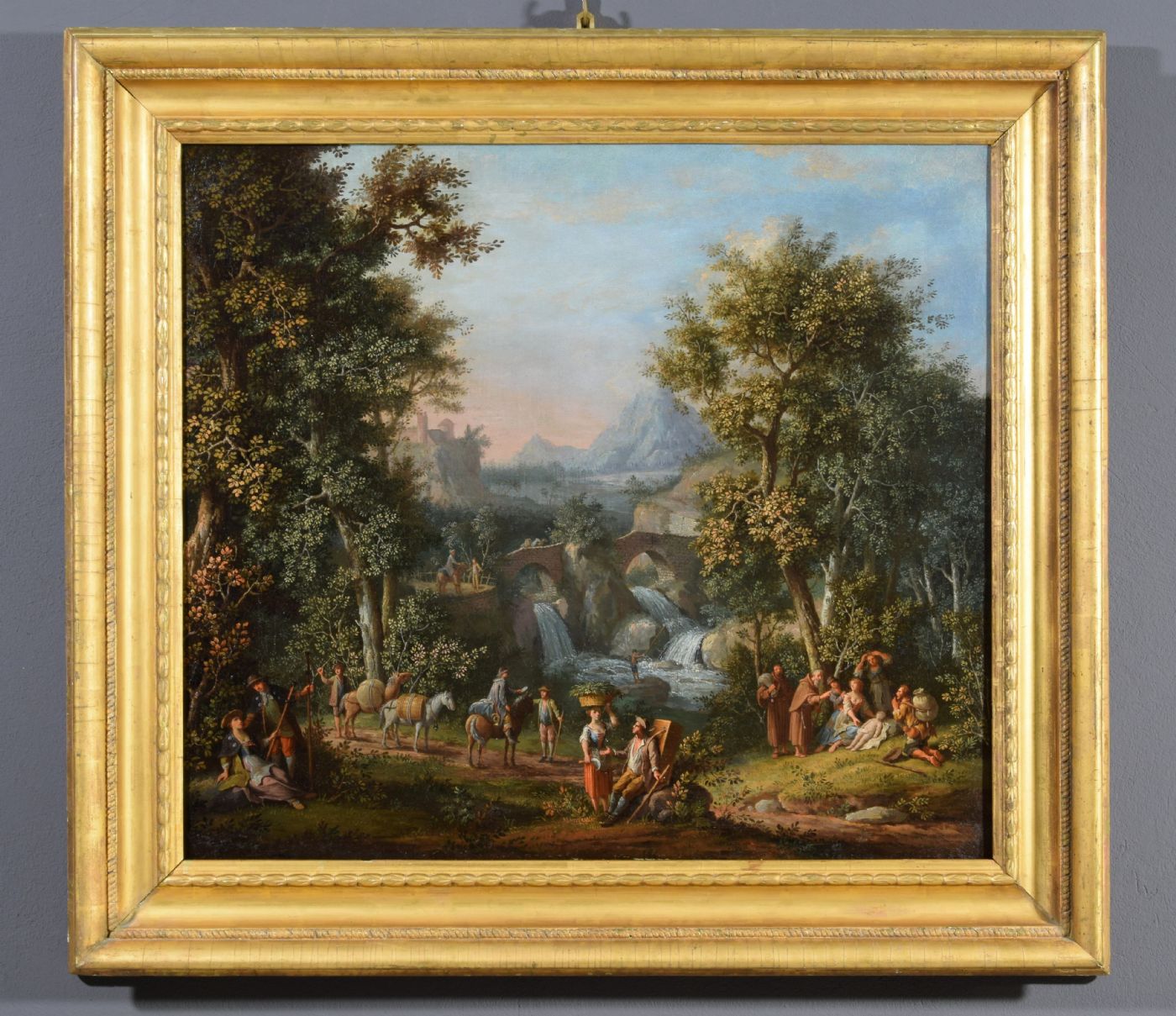
Giovanni Battista Innocenzo Colomba (1713 – 1793), Wooded landscape with figures Oil on canvas, Frame H 102 x W 112 x D 8; canvas H 77 x W 87 Price: confidential negotiation Object accompanied by a certificate of authenticity and expertise (downloadable at the bottom of the page) The valuable painting, attributable to the painter Giovanni Battista Innocenzo Colomba (1713 – 1793), depicts a wooded landscape animated by figures. In the center of the canvas, there is a two-arched bridge from which lively waterfalls gush, characteristic of the painter's works. Beyond the bridge, built in brick and crossed by some wayfarers with steeds, the landscape opens, hilly, before being delimited by large mountains that lighten in the distance. A fortress shows a turreted castle that dominates the void. In the foreground, along a path, several people are captured and portrayed in their everyday lives. From the left, a pair of travelers are taking a break, while a little behind, others, accompanied by horses, continue their journey. In the center, two peasants, she with a wicker basket on her head brimming with wheat and a sickle in her hand, he sitting, with a stick and a wicker basket on his shoulders, are engaged in a dialogue, while on the right two humble parents pray before a child who needs care. To the dramatic scene, full of pathos, enhanced by the comforting and worried gestures of two people who rush to help, a pair of friars join through a gesture of blessing, recalling the power of faith and hope. It is therefore a work of beautiful workmanship, very pleasant aesthetically and certainly decorative. However, the landscape and the many characters described conceal a richer and more vigorous message of faith that the author develops with discretion and descriptive force. In the work, the style that distinguishes the works of the mature painter is immediately recognizable, in which the lively and luminous palette is accompanied by fine brushstrokes to form landscapes that oscillate between Rococo and Neoclassicism. Giovanni Battista Innocenzo Colomba (1713 – 1793) was born in Arogno (Canton Ticino), in a family of painters, stucco artists and architects whose progenitor can be traced back to Andrea Colomba (1567-1627). He learned painting from his uncle, Luca Antonio Colomba, painter at the Württemberg court in Germany, and around 1737 he was an independent painter in Mainz, where he executed several frescoes and decorations. It is likely that he completed his training at the Vienna Academy, in those years a fundamental center of aggregation and cultural exchange. He had an intense activity as a set designer and decorator at various princes. In 1741 in Frankfurt he executed the decoration, with squares and allegorical paintings, of the ceiling of the "Imperial Staircase" of the Römer (destroyed in the Second World War), on the occasion of celebrations for the coronation of Charles VII as emperor (February 12, 1742). In 1748 he was called to Hamburg where he worked in Schleswig-Holstein (large fresco, in the church of Uetersen with Glorification of the Trinity). In Hanover he became court painter to George II. In 1751 he went into the service of the Duke of Württemberg. In Ludwigsburg and Stuttgart he had an important position for the grand court celebrations. He was a professor at the Academy of Arts in Stuttgart founded by Charles Eugene in 1761. By 1763 he worked in Italy: on that date the new theater in Como was inaugurated, in which Colomba worked for many scenes. In the same city he painted the choir of S. Giacomo and the church of the Benzi seminary. The painter moved to Turin where he took the place of the Galliari brothers, signing in 1769 the capitulation with the Society of Knights which administered the Teatro Regio. The relations with the Turin theater, where he worked for two seasons until 1771, were however riddled with endless disputes. In the years 1774-1780 he is documented in London as a painter of landscapes and scenery at the King's Theatre and in 1775 he set up a theater in Weston Hall for Sir Henry Bridgeman. The London stay allowed him an early opening towards pre-Romantic aesthetics, which can be seen in the landscapes executed in that period. From 1780 he settled permanently in Arogno and in 1792 he painted three canvases in the church of S. Carlo in Poschiavo in Valtellina with S. Remigio baptizing Clovis, S. Rocco among the plague victims and the Annunciation. In these last works his style oscillates between classicist and still Baroque aesthetics, evidently in tune with the tastes of the client. According to tradition he died in Arogno in 1793. The canvas object of this study presents the unmistakable stylistic manner of the artist. The work can be compared to several canvases signed or returned with certainty to the production of Giovanni Battista Innocenzo Colomba, where we find the same treatment of atmospheric light, the foliage of the trees, the scenographic compositional layout and great perspective depth. Equally coherent is the color scheme used, particularly recognizable in reds and greens, browns and blues. Several elements return, such as the presence of water, the broad green foliage described with light research and the lively figures portrayed never in static poses but with attention to capturing a precise moment, giving movement and pathos to what is depicted. Carlotta Venegoni
Period: Second half of the 18th century